Tuesday, February 25, 2014

Hip Philosophers: Short List for 2014

Though last year's was deleted, "Hip Philosophers: the Short List" is brought back by demand with an all new line up.

This is, of course, *tongue in cheek* so no one should get worked up. So relax, it's just snarkiness mode "lite." But, an After Nature reader said I had to do it because last year's list was, to use his language, "so f'n future." Happy to oblige.


Hip Philosophers: The Short List for 2014

1. Mehdi Belhaj Kacem. (Enough said.)
2. Catherine Malabou. (Originally you might say she is so "two year's ago" but her continued emphasis on Hegel has her making a strong comeback. Someone to be reckoned with, bet on it.)
3. Adrian Johnston. (Easily could have taken the number two spot, but...putting out a book with you-know-who's series has too many folks rolling their eyes and walking right by that one. Stll, the Northwestern UP trilogy of books ought to prove incredible, the first part is geat. )
4. Ray Brassier. (Naturalism and a "post" SR vibe never goes out of style even though SR itself is completely out of style.  Brassier is the man.)
5. Tie between Iain Grant and Robert Corrington. Iain's work continues to amaze: German idealism, Schelling and Hegel are "hot" right now, and he edges out others working in German idealism as he is delivering a number of talks on that and nature, which is - it seems - what folks want to hear about. Corrington who? He's now on the map at that "Jane Bennett" level, alot of curiosity about him, again, because of the Hegel/Schelling/nature/realism connection.  Be on the lookout for Corrington and Grant this year.

Runners up:
1. Philippe Descola; Eduardo Viveiros de Castro (both likely on for next year, we just need more from them).

Knocked off the list:
1. Quentin Meillassoux. (A book mostly about Issac Asimov just won't cut it. Sorry.)
2. Tristan Garcia. (Owned by Kacem. Besides, no one's doing "flat ontology" since Buchler grabbed that one quite awhile ago. Ante up TG.)

As a blog that I like to read (seriously) states, "You've been fed!"

Tuesday, February 18, 2014

cold materialism

"A cold wind blows across empty space.  Dark matter obscures the sun.  Wreckage of exploded stars drifts in the void, the ruins of a solar system, burned-out at 3,000K, radiating annihilation in all directions.  A single beam of light, cutting through the gloom, frames the silhouetted body of a dead God, stretching cruciform across the galaxy, face taut with pain, spikes wounding wrist and ankle - borne continually upwards towards the vault of the Heavens, where divinities go to die, but all the while drawn down into the abyss below...

Shadows black out the horizon in a single stroke.  Morbid expectations of apocalypse.  Ledgers kept in minute detail plot the geometries and timescales of the end of the world.  Vertigo and nausea proliferate, requiring that the stomach expands to accommodate ever greater magnitudes of sickness.  Pulsing chaos tears apart the fabric of the universe...

So what was it that ruined this passional gothic theatre of obliteration?  What was it that robbed us of the cosmic spectacle of all sinners falling to their knees, hands outstretched in terror, before being wiped out in the final holocaust of divine judgment?  It was this:  something like divine order without God."

Aion, the dark precursor.  A kind of cosmic unconscious that, like Nietzsche's Dionysus, is the god of indestructible life, joy, and power; though like Abraxas, progenitor of Nous, is full of sorrow, melancholy, and tears.  A profoundly schizoid God - divinity, a One that is many - a divine impersonal process of both frozen eternity and creative thawing.  Matter frozen in hindsight, empty, dead husks of matter whose cold exterior hides spiritual interior, like the frozen surface of Europa, Jupiter's moon.

Deleuze writes that "God..[is]...himself a modification of modifications."  Or, in Schelling's words, the Absolute involves a divine game of chance, but also love.  Wrath precedes love.  Darkness precedes light.

Sublime unconscious, immanent life, divinity.  Schizophrenic God that is "impenetrably dark."  H.P. Lovecraft's "Outsider abominations."

Ungrund, Urgrund, Abgrund.  The Dark Pleroma.  The depth of the world, the abyss, home of countless "little divinities."  Surplus and abundance of intensity, not just light and life; sorrow, darkness, and death.

Metamorphosis.   Creation.

"Such a becoming God as the becoming depth of nature is not a fundamentally singular God, but rather an elohimic multiple,' an originating beginning as difference, a multiplicity of differences-in-relation, a multiplicity that as such is the relational..."

Unrecognizable, a dark origin.  A self-expressing dark origin, "out of which all comes to be and into which all things pass, as into an ultimately inarticulate night."

A bright abyss that overreaches thought.  The vital negative, intensive "0" or Being of zero degree.  Fecund non-existence that may give birth even to a God (Meillassoux), the virtual πλήρωμα.

[Notes from "Deleuze and Theology" reading group, December-January 2013/14.]


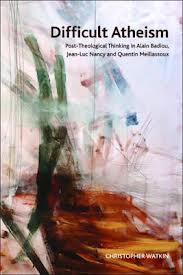
Caputo's review of Watkin's Difficult Atheism book at NDPR

A bit dated review (from 2012) but I believe the more affordable paperback version of Watkin's book only came out last year, so it's really only been available for the casual reader for not too long.

John D. Caputo reviews Christopher Watkin's Difficult Atheism: Post-Theological Thinking in Alain Badiou, Jean-Luc Nancy, and Quentin Meillassoux HERE.

Sunday, February 16, 2014

on the tragedy of life

Although I am not technologically savvy enough to figure out how many times any one specific mp3 has been downloaded from my blog, I was amazed to see that quite a number of folks downloaded the only two items that I've posted to my academia.edu page (which does have a counter) in the mere week or so that those items have been up.

I am guessing that the mp3s posted on my blog are downloaded frequently, as those links on my academia page received some great traffic in a very short period of time, and the majority of the downloads on my academia page were routed from my blog (furthering my thought that while not many people actually use academia.edu on a frequent basis, it still can be a great source of exposure for one's work).

The topics of the lectures deal with melancholy and my position of "bleak theology" or "bleak metaphysics," part of my overall project of speculative naturalism.  I am amazed by the response that I've gotten so far and am encouraged by how many folks downloaded the talks in the week that they've been up.

For those interested, the bleak metaphysical perspective is something that I've been working on behind the scenes for awhile.  For the foreseeable future I plan to keep reading/researching in this area.

See for example:

"Bleak Metaphysics" lecture (MP3 audio download)

"Speculative Naturalism: A Bleak Theology in Light of the Tragic"

"God is in Pain"

"Melancholy and the Otherness of God"

"Peirce's Melancholy"

"Bleak Theology on Bleak Theology"

"Guest post in Bleak Theology/Speculative Naturalism" (guest post for the website Homebrewed Christianity)

And speaking of bleakness and melancholy: Schopenhauer, Nietzsche, and their connections to a bleak perspective make appearances rather timely for me in this recent 3:AM interview HERE.


Saturday, February 15, 2014

Mute magazine and E-flux

The latest issue of E-flux is now out, and perusing it I have been reading Negarestani's latest piece HERE. It is highly recommended if you haven't looked at it already.

Mute magazine is also on fire having published papers from December's Accelerationism Symposium.  (As an aside, I found an intriguing article by Simon Mussell from an older issue HERE.  The article incidentally mentions yours truly in its first footnote!)

Function: Decomposition, Localization, Abstraction- Workshop feat. Brassier & Negarestani in NYC

Function: Decomposition, Localization, Abstraction Speakers: Ray Brassier, Reza Negarestani. March 25th, 6:30pm @ The New School. 
Although principally associated with a thesis in the philosophy of mind, functionalism has wide-ranging ramifications. The concept of "functional role" or "functional organization" ties together a metaphysical problem about the basis of the distinction between matter and form, an epistemic problem about how to distinguish semantic content from physical information, and an engineering problem about the relation between structural and functional properties. This workshop will try to unravel the metaphysical, epistemic, and engineering aspects of functionalism by developing themes from the work of philosophers including William Bechtel, Robert Brandom, Wilfrid Sellars, and William Wimsatt. 
Hosted by the Center for Transformative Media at The New School. 
Tickets HERE

Ray Brassier "Wandering Abstraction" published in Mute

http://www.metamute.org/editorial/articles/wandering-abstraction

Friday, February 14, 2014

update on my book through Open Humanities Press

I heard from Joanna of OHP yesterday and now that the first draft of Animal Experience: Consciousness and Emotions in the Natural World is done she states that it should be about three months of review and editing until official publication of the book.  We have been told that the book (hopefully) will appear before the end of June.  As After Nature readers know, last year we began work on the book which is to appear through Open Humanities Press' "Living Books About Life" series.

Now that we are finished and have some hindsight on the project, I am proud to say that I am quite happy with how the book turned out.  There is a fairly large introduction, an extensive bibliography, and a table of contents featuring some very interesting cutting edge research.  The most intriguing part, I think, is the last section which focuses on philosophical views of animals and the emotions.  There you'll find work presented by Philippe Descola, Isabelle Stengers, and Bruno Latour.

Others who have published in the series include Dave Berry, Jussi Parikka, Claire Colebrook, and Steven Shaviro, to name a few.

I am excited for After Nature readers to see this new volume of OHP appear!


Living Books About Life from Peter Woodbridge on Vimeo.

Thursday, February 13, 2014

quote of the day

"Spirit is absolute unrest."

- John Dewey (1897), "Hegel's Philosophy of Spirit," in John Dewey's Philosophy of Spirit: With the 1897 Lecture on Hegel (New York, Fordham UP: 2010), 114.