Wednesday, October 25, 2017
Speculative Realism selling extremely well
I have to gush for a moment at this phrase in particular from a forthcoming review about to appear in a very good Continental philosophy journal which states, "Speculative Realism: An Epitome is the best book about 'Speculative Realism' yet." The review in large part appears to appreciate the honesty with which the book was written and how it provides a history of speculative realism as it really happened, something other books refuse to do in the name of pathetic alliances or vain attempts to put one's self over. But blog kingpins and internet wizards have no power outside of the "journals" (and I truly do hesitate to even use that word, and really I should say "journal" as in the singular, because there is only one that I know of, and it hasn't put out an issue in about two years or more) or book series, or other venues that they themselves have created to manufacture the studio-like reality which would suggest that their silly views actually have any sort of current impact in the academy at large, at all, or that these folks are in any way, well, still relevant. They aren't, so don't be fooled.
Like I said before - there are quite a few poseurs and charlatans out there, and, yes, by and large they are ignored. Still, you have a few losers shouting from the sidelines refusing to go home, aged and tired as they are. The nail is in the coffin, and this book is the eulogy. The best one yet, apparently.
Accordingly, I've been told that the book is selling like "hotcakes" and copies of it don't remain on the shelves for very long. The voices in this book have been silenced for too long and I think folks appreciate that those voices are finally allowed to speak.
According to amazon it was the number one selling book in metaphysics and phenomenology, and for awhile was outselling all other books on speculative realism out there.
Not too shabby if I say so myself.
Tuesday, October 24, 2017
Life is not easily bounded (Aeon article)
We may all too easily misattribute the accelerating development of intelligence throughout the natural world to some sort of vital principle, elan vital, or conscious mind of God, working itself out toward a greater form of generality (and this is in part true, although it is not necessarily a conscious process of a divine being) when in fact there is at the very minimum a more basic principle of Gnon at work: Reality Rules.
Reality's processual inclination toward Promethean heights unbound in and of itself knows no limit. It is "not easily bounded."
----
Life is not easily bounded
// Aeon

Working out where one hare ends and another begins is easy; a siphonophore, not so much. What is an individual in nature?
By Derek J Skillings
Read at Aeon
Life is not easily bounded
// Aeon

Working out where one hare ends and another begins is easy; a siphonophore, not so much. What is an individual in nature?
By Derek J Skillings
Read at Aeon
New theory of why the universe is three dimensional draws upon Hegelian trichotomic ontology
As it turns out, the Schelling-Hegel-Peirce axis explains the universe. Onto-cosmological "intercommutations lead to the well-known scaling behavior in cosmic string networks" - structurally in essence the categories of Firstness, Secondness, and Thirdness; Schellingean invisible matter; Hegelian synthesis incarnate.
Geesh, haven't thought about that sort of thing in a long, long while.
----
A New Theory Explains Why the Universe Is Three Dimensional
https://www.space.com/38538-a-new-theory-explains-why-the-universe-is-three-dimensional.html
----
Monday, October 23, 2017
He died as he lived: David Hume, philosopher and infidel (Aeon article)
This morning was a creaky, slow start. My students, subjected to Hume on a Monday morning, nevertheless found out that Hume thought that morality was a matter of our passions, our feelings, much the same as "reason" was said to be - that "rationality" is a matter of our feelings as well. Moreover, class ended on the note that Hume never gave up his strictly held view that "God" is not much more than fantasy. Wishful thinking and God go hand in hand, Hume thought. But which is the more controversial and challenging idea? Hume's atheism or his repudiation of reason and any corresponding "necessity" in the name of "animal faith"?
The Aeon article below, which I've decided to republish in full (thanks to the Aeon Creative Commons license they allow and actually encourage this) charts Hume's atheism and its shocking results of a man who never gave up his atheistic beliefs.
----
He died as he lived: David Hume, philosopher and infidel
// Aeon
The Aeon article below, which I've decided to republish in full (thanks to the Aeon Creative Commons license they allow and actually encourage this) charts Hume's atheism and its shocking results of a man who never gave up his atheistic beliefs.
----
He died as he lived: David Hume, philosopher and infidel
// Aeon

As the Scottish philosopher David Hume lay on his deathbed in the summer of 1776, his passing became a highly anticipated event. Few people in 18th-century Britain were as forthright in their lack of religious faith as Hume was, and his skepticism had earned him a lifetime of abuse and reproach from the pious, including a concerted effort to excommunicate him from the Church of Scotland. Now everyone wanted to know how the notorious infidel would face his end. Would he show remorse or perhaps even recant his skepticism? Would he die in a state of distress, having none of the usual consolations afforded by belief in an afterlife? In the event, Hume died as he had lived, with remarkable good humour and without religion.
The most famous depiction of Hume’s dying days, at least in our time, comes from James Boswell, who managed to contrive a visit with him on Sunday, 7 July 1776. As his account of their conversation makes plain, the purpose of Boswell’s visit was less to pay his respects to a dying man, or even to gratify a sense of morbid curiosity, than to try to fortify his own religious convictions by confirming that even Hume could not remain a sincere non-believer to the end. In this, he failed utterly.
‘Being too late for church,’ Boswell made his way to Hume’s house, where he was surprised to find him ‘placid and even cheerful … talking of different matters with a tranquility of mind and a clearness of head which few men possess at any time.’ Ever tactful, Boswell immediately brought up the subject of the afterlife, asking if there might not be a future state. Hume replied that ‘it was possible that a piece of coal put upon the fire would not burn; and he added that it was a most unreasonable fancy that we should exist for ever’. Boswell persisted, asking if he was not made uneasy by the thought of annihilation, to which Hume responded that he was no more perturbed by the idea of ceasing to exist than by the idea that he had not existed before he was born. What was more, Hume ‘said flatly that the morality of every religion was bad, and … that when he heard a man was religious, he concluded he was a rascal, though he had known some instances of very good men being religious.’
This interview might show Hume at his brashest, but in the 18th century it remained mostly confined to Boswell’s private notebooks. The most prominent and controversial public account of Hume’s final days came instead from an even more famous pen: that of Adam Smith, Hume’s closest friend. Smith composed a eulogy for Hume soon after the latter’s death in the form of a public letter to their mutual publisher, William Strahan. This letter was effectively the ‘authorised version’ of the story of Hume’s death, as it appeared (with Hume’s advance permission) as a companion piece to his short, posthumously published autobiography, My Own Life (1776).
Smith’s letter contains none of the open impiety that pervades Boswell’s interview, but it does chronicle – even flaunt – the equanimity of Hume’s last days, depicting the philosopher telling jokes, playing cards, and conversing cheerfully with his friends. It also emphasises the excellence of Hume’s character; indeed, Smith concluded the letter by declaring that his unbelieving friend approached ‘as nearly to the idea of a perfectly wise and virtuous man, as perhaps the nature of human frailty will permit’.
Though relatively little known today, in the 18th century Smith’s letter caused an uproar. He later proclaimed that it ‘brought upon me 10 times more abuse than the very violent attack I had made upon the whole commercial system of Great Britain’ – meaning, of course, The Wealth of Nations (1776). Throughout his life, Smith had generally gone to great lengths to avoid revealing much about his religious beliefs – or lack thereof – and to steer clear of confrontations with the devout, but his claim that an avowed skeptic such as Hume was a model of wisdom and virtue ‘gave very great offence’ and ‘shocked every sober Christian’ (as a contemporary commented).
Boswell himself deemed Smith’s letter a piece of ‘daring effrontery’ and an example of the ‘poisonous productions with which this age is infested’. Accordingly, he beseeched Samuel Johnson to ‘step forth’ to ‘knock Hume’s and Smith’s heads together, and make vain and ostentatious infidelity exceedingly ridiculous. Would it not,’ he pleaded, ‘be worth your while to crush such noxious weeds in the moral garden?’
Nor did the controversy subside quickly. Nearly a century later, one prolific author of religious tomes, John Lowrie, was still sufficiently incensed by Smith’s letter to proclaim that he knew ‘no more lamentable evidence of the weakness and folly of irreligion and infidelity’ in ‘all the range of English literature’.
In the 18th century, the idea that it was possible for a skeptic to die well, without undue hopes or fears, clearly haunted many people, including Boswell, who tried to call on Hume twice more after their 7 July conversation in order to press him further, but was turned away. Today, of course, non-believers are still regarded with suspicion and even hatred in some circles, but many die every day with little notice or comment about their lack of faith. It takes a particularly audacious and outspoken form of non-belief – more akin to the Hume of Boswell’s private interview than to the Hume of Smith’s public letter – to arouse much in the way of shock or resentment, of the kind that attended the death of Christopher Hitchens some years ago. (Indeed, there were a number of comparisons drawn between Hitchens and Hume at the time.) The fact that in the 18th century Smith endured vigorous and lasting abuse for merely reporting his friend’s calm and courageous end offers a stark reminder of just how far we have come in this regard.
Dennis Rasmussen
This article was originally published at Aeon and has been republished under Creative Commons.
Saturday, October 21, 2017
Call for Papers: North American Schelling Society 6
Call
for Papers
Schelling
and Philosophies of the Earth
Sixth
Annual Meeting of the North American Schelling Society
5-8
September 2018
Volcanoes
National Park, Hawaiʻi
NASS
invites presentations on vulcanism, the world-soul, and the powers of
nature, and their relationships to other areas of Schelling’s
philosophy. Submissions on other topics related to Schelling studies
are also welcome. Papers
may be presented in English, French, German or Spanish. Conference
events and lodging will be located inside Volcanoes National Park on
the Big Island of Hawaiʻi.
The venue is remote, but transportation from the Hilo airport to the
park will be available. NASS deplores the U.S. government’s recent
travel restrictions and will work with presenters to help secure
visas.
Send
500-word proposals for thirty-minute presentations, prepared for
blind review, to Chris Lauer (lauer3@hawaii.edu) by January
15, 2018.
Acceptance letters will be sent by February 8, 2018.
Thursday, October 19, 2017
more on Roaming Millennial and the Lafayette debacle
The excerpts pretty much speak for themselves. While I do agree there was some pretty questionable behavior on behalf of some the students in the video, some of Roaming's generalizations about the academy, on the other hand, aren't entirely accurate - at least as she presents many of those generalizations in her video where they are intended as a critique of college, college students, or the academy at large. It's one thing to judge one "campus bubble" based on some ridiculous behavior as enacted by some of its students, but another to extend that critique to the academy or to college students (and professors) overall. Moreover, Roaming makes the statement that if one "literally" (why is everything always phrased as "literally," by the way) steps off campus into the outside town - incidentally where Moravian College is nearby by the way - and then speaks to "non-academics," one would find that they would be speaking to "Trump-supporters." If we are speaking in literal terms, stepping off of Lafayette's campus places one in Easton, Pennsylvania - a population that did not largely vote for Trump. This is why it is dangerous to bandy about the term "literally."
As Moravian College is also in Northampton County I would like to venture the claim that my students would not behave like some of those students did in the video despite their possible political differences.
In her response-video Roaming then continues to characterize "college students" and their lack of ability to martial statistics (within arguments or lack thereof). Again, such may be true of those students - but most definitely not mine. I know for a fact that my students in preparing for the ethics bowl, for example, talk about numbers but do so intelligently and without falling prey to emotion. Being philosophically trained, they know better.
I think it would be fruitful for Roaming to come to Moravian College campus and chat with our ethics bowl team if only because of the environment within which productive discourse might occur, but also because of the nature of those engaging in the exchange of ideas (good students, open and honest discussion). Here I would think there would be a positive, open, and kind environment conducive to discourse and the exchange of ideas. Meaning, if anything, the environment and the mode of discourse available between she and the students would be de-politicized to the extent that the focus would be upon the values, issues, and arguments at stake rather than upon (or being about) hurt feelings provoked by irrationalism and ad hominem attacks. In essence, then, we would be re-routing our understanding of the politicization of feelings versus arguments, productive discourse and debate versus unsupported statements of belief and opinion, and the practice of courtesy and charity in the course of debate and discussion over expression of belief and opinion at any cost. Thus the conditions of discourse are observed to be just as important as the nature of any productive discourse itself. Finally, let me close by saying I am not saying our college or students are better than any other; I am only mentioning that I think Moravian's students are among those who value productive dialogue as much as anyone else. If someone thinks that all local college students in the area of Lafayette act similarly as to some of those in the video then I would urge them to reconsider.
So, the invitation is still open if Roaming Millennial would like a re-introduction to the area through another local college and hopefully a more suitably behaved and philosophically rigorous set of interlocutors.
As Moravian College is also in Northampton County I would like to venture the claim that my students would not behave like some of those students did in the video despite their possible political differences.
In her response-video Roaming then continues to characterize "college students" and their lack of ability to martial statistics (within arguments or lack thereof). Again, such may be true of those students - but most definitely not mine. I know for a fact that my students in preparing for the ethics bowl, for example, talk about numbers but do so intelligently and without falling prey to emotion. Being philosophically trained, they know better.
I think it would be fruitful for Roaming to come to Moravian College campus and chat with our ethics bowl team if only because of the environment within which productive discourse might occur, but also because of the nature of those engaging in the exchange of ideas (good students, open and honest discussion). Here I would think there would be a positive, open, and kind environment conducive to discourse and the exchange of ideas. Meaning, if anything, the environment and the mode of discourse available between she and the students would be de-politicized to the extent that the focus would be upon the values, issues, and arguments at stake rather than upon (or being about) hurt feelings provoked by irrationalism and ad hominem attacks. In essence, then, we would be re-routing our understanding of the politicization of feelings versus arguments, productive discourse and debate versus unsupported statements of belief and opinion, and the practice of courtesy and charity in the course of debate and discussion over expression of belief and opinion at any cost. Thus the conditions of discourse are observed to be just as important as the nature of any productive discourse itself. Finally, let me close by saying I am not saying our college or students are better than any other; I am only mentioning that I think Moravian's students are among those who value productive dialogue as much as anyone else. If someone thinks that all local college students in the area of Lafayette act similarly as to some of those in the video then I would urge them to reconsider.
So, the invitation is still open if Roaming Millennial would like a re-introduction to the area through another local college and hopefully a more suitably behaved and philosophically rigorous set of interlocutors.
Wednesday, October 18, 2017
Mathematics and Its Applications, A Transcendental-Idealist Perspective (NDPR Review)
Coincidental? Alain Badiou's lecture, this, and the fact that this afternoon a brilliant student who is interested in the philosophy of mathematics is coming by so we can think about an independent study and an institutional research-award project on some narrowed down issue or problem within the philosophy of mathematics. Hmmm, pretty cool.
----
Mathematics and Its Applications, A Transcendental-Idealist Perspective
// Notre Dame Philosophical Reviews // News
2017.10.18 : View this Review Online | View Recent NDPR Reviews
Jairo José da Silva, Mathematics and Its Applications, A Transcendental-Idealist Perspective, Springer, 2017, 275pp., $99.00 (hbk), ISBN 9783319630724.
Reviewed by Mirja Hartimo, University of Jyväskylä, Finland
Jairo José da Silva formulates a transcendental-idealist approach to mathematics. Appropriating (he is explicit about not engaging in any kind of exegesis) some central notions of Husserl's phenomenology, da Silva holds that mathematics is "intentionally posited" in the mathematical community, in communal work that has been carried out for centuries. "Intentional acts," such as intuiting or empty intending, put something with characteristic features and properties in front of the subject (28). If such positing is consistent, the intended object comes into existence (29). This allows viewing the existence of formal objects "on their own terms," as intentionally posited by the mathematicians. This leads da Silva to embrace a structuralist, and also Platonist, view of formal objects, corresponding not to metaphysical...
Read More
----
Mathematics and Its Applications, A Transcendental-Idealist Perspective
// Notre Dame Philosophical Reviews // News
2017.10.18 : View this Review Online | View Recent NDPR Reviews
Jairo José da Silva, Mathematics and Its Applications, A Transcendental-Idealist Perspective, Springer, 2017, 275pp., $99.00 (hbk), ISBN 9783319630724.
Reviewed by Mirja Hartimo, University of Jyväskylä, Finland
Jairo José da Silva formulates a transcendental-idealist approach to mathematics. Appropriating (he is explicit about not engaging in any kind of exegesis) some central notions of Husserl's phenomenology, da Silva holds that mathematics is "intentionally posited" in the mathematical community, in communal work that has been carried out for centuries. "Intentional acts," such as intuiting or empty intending, put something with characteristic features and properties in front of the subject (28). If such positing is consistent, the intended object comes into existence (29). This allows viewing the existence of formal objects "on their own terms," as intentionally posited by the mathematicians. This leads da Silva to embrace a structuralist, and also Platonist, view of formal objects, corresponding not to metaphysical...
Read More
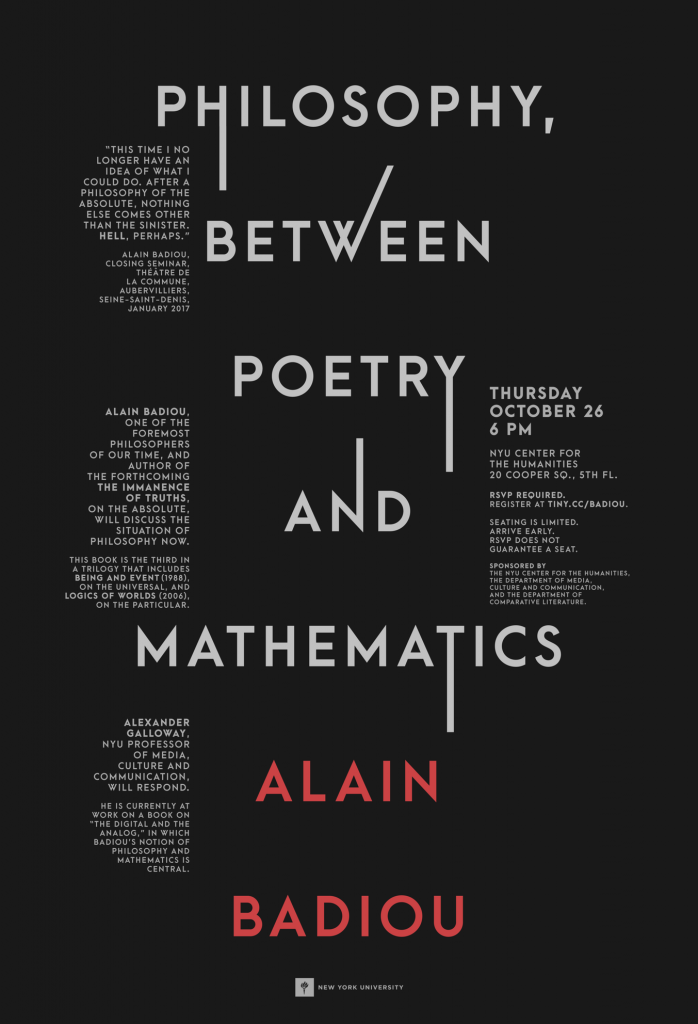
Alain Badiou at NYU
Thanks to Alex Galloway for the announcement.
----
Alain Badiou at NYU
// Alexander R. Galloway
Please join us for a lecture by Alain Badiou at NYU on October 26 at 6pm. I will be acting as respondent.

----
Alain Badiou at NYU
// Alexander R. Galloway
Please join us for a lecture by Alain Badiou at NYU on October 26 at 6pm. I will be acting as respondent.

quote of the day
- Gilles Deleuze, Logic of Sense (1969)
Tuesday, October 17, 2017
For a New Naturalism
You can read the introduction online, HERE.
Monday, October 16, 2017
YouTuber Roaming Millennial visits Lafayette College
Roaming Millennial (a vlogger on YouTube) visited Lafayette College not so long ago. This is pretty close to where I teach at Moravian so had I known it was going on I would have gone. Might be interesting to bring Roaming Millennial to Moravian College - afterall, she declares herself to be a "philosopher king" and we just finished the Republic. She would also be an interesting figure to talk to our ethics bowl team.
It's here! Watch my contentious Q&A at Lafayette College.— Roaming Millennial (@RoamingMil) October 14, 2017
Warning: You may want to take an Advil before starting 😖https://t.co/7D11NV4eu2
Subscribe to:
Posts (Atom)